Theoretical reconstruction of an ancient astrolabe
The Roman re-enactment scene serves as a framework where people from different educational backgrounds and interests can meet. People who look at the same text or object, but from a different perspective. And this can produce fascinating results.
In the astrolabe, technology and aesthetics blend into each other. I was fascinated by this technical art object because of its elegant symmetrical lines, long time before I understood how this instrument was created and how it functioned. To create this Greek invention, mathematical operations are performed and a good understanding of the celestial bodies and their relative movements is required.
This research is a collaboration between an architect from Kiev, an engineer from Rome and myself. We wondered: how would an ancient Greek astrolabe have looked like? Which archaeological sources are available? This was the start of our research, which lasted several years. Just a few more months of sleep, and our research document will become available. Be sure to let me know if you want to read/review this document.
Because the reproduction is already finished, you can find the visual results in the below.

The main parts of an astrolabe are:
Rete (top, left): the pointed triangles on this metal skeleton reflect the star positions. By turning the rete, the movement of the stars is simulated.
Three tympans (bottom): on both sides of a tympan the stereographic projection of a certain latitude is engraved.
Mater (top, middle): this is where the three tympans and the rete fit into.
Alidade (top, right): allows you to measure the angle of the sun (during the day) or a star (at night).

This is the operational reproduction of the astrolabe.
This mechanical computer from antiquity allows you to solve an equation with four variables:
- the latitude
- the position of a star (the sun is also a star)
- the calendar day in the solar year (translated towards the zodiac)
- the hour
Once you know the values of three of these variables and set them on the astrolabe, you can read the value of the fourth variable.
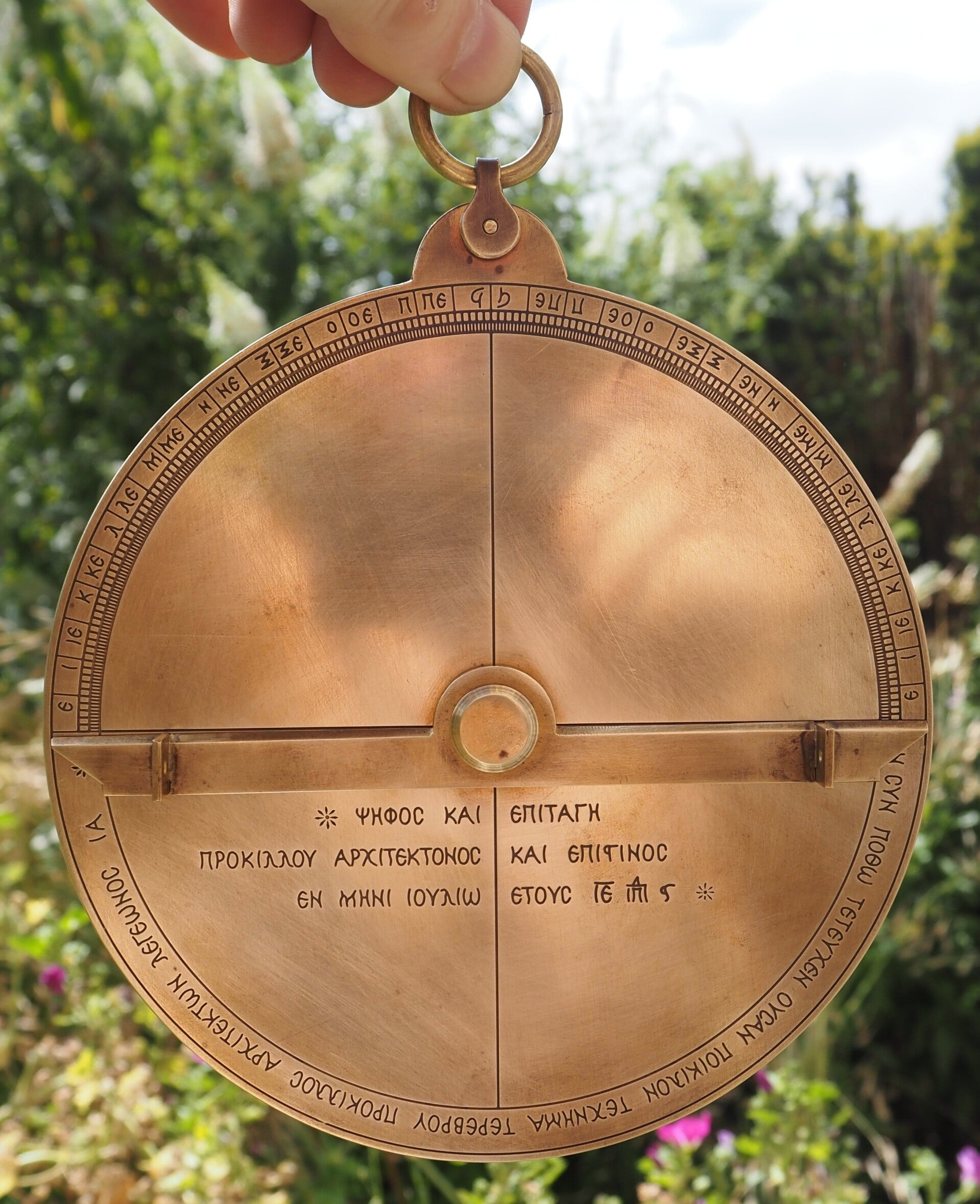
The Greek engravings are largely based on the available sources. The astrolabe was a status object and was personalized at the owner's request, something we also did in our reconstruction.
The horizontal text on the back translates to:
'Decree and command of Prokillos, architectus and man of science, in the month of July, fifteenth year, sixth indiction.'
An indiction (Latin: 'indictio') was an administrative period of 15 years. After this period, the amount of taxes to be paid was reevaluated, and a new indiction began.

The design decisions of our theoretical reconstruction are based on various sources:
- Islamic astrolabe (8th century AD)
- Byzantine astrolabe (11th century AD)
- portable sundials
- ancient and Arabic manuscripts
- Antikythera mechanism
- ...


The astrolabe is an astronomical and mathematical puzzle.
Plans and diagrams on parchment help to visualize the construction and operation of the astrolabe.


The astrolabe in use. The alidade can be used to measure the angle of a star.
This angle can then be set by aligning the pointer of that star on the rete with the measured latitude line.
With thanks to
Sources
O. M. Dalton wrote an important article, where he identified the only extant astrolabe with Greek inscriptions as a Byzantine astrolabe.
David A. King worked as Professor of Near Eastern Languages and History of Science at New York University from 1979-1987, and as Professor of History of Science and Director of the Institute for the History of Science, Johann Wolfgang Goethe University in Frankfurt am Main from 1985-2007. 'In Synchrony with the Heavens, Studies in Astronomical Timekeeping and Instrumentation in Medieval Islamic Civilization, Volume Two, Instruments of Mass Calculation' and 'The Byzantine Astrolabe of 1062, 2007/2018. Astrolabes and Angels, Epigrams and Enigmas' are works from his hand, and were pivotal for our project.
Thanks to the groundbreaking research of O. M. Dalton and David A. King this project could materialize.
The above and other references can be found in Bibliography.
Cooperation
This research was a collaboration between Vsevolod, Salvatore and myself.
Vsevolod Buravchenko is an architect with a Ph.D in applied geometry. He works as an associate professor at Kyiv National University of Construction and Architecture. He founded the project of study and recreation of historical instruments of science ‘Master Terebrus’ (www.terebrus.wordpress.com). Vsevolod handled the technical drawings, the fabrication and post-processing and the coordination with the artisan.
Salvatore Falco has a degree in MSc in Communications Engineering, with an expertise in the field of SAR remote sensing. When Salvatore joined this project, he added a wealth of knowledge related to the ancient writers (Ptolemy, Synesius of Cyrene, Severus Sebokht, Johannes Philoponus, ...) and astronomy.