Medallion sundial
The medallion sundial was a small, portable sundial. Some versions of this type of sundial could only be used at one latitude, whilst others were usable at eight latitudes.
The reproduced sundial is based on the archaeological find on display at the Kunsthistorisches Museum in Vienna, Austria.
Video explanation
This video explains the different components and the operation of the medallion sundial.
Archeological finds
Four archaeological finds proof to the existence of the medallion sundial in classical antiquity. These finds are sometimes fragmentary, with only a single disc remaining. In other finds, virtually all parts of the sundial have been preserved.
Find 1
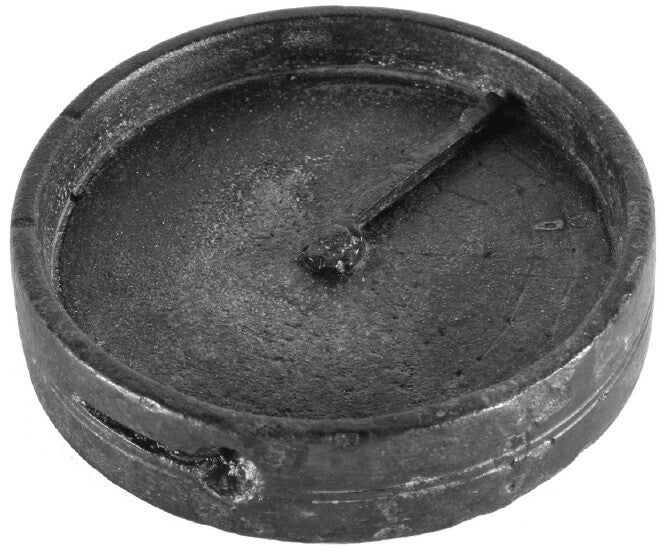
Box with ruler to indicate the hour (Musée de La Cour d’Or, Metz, Franrijk).
Find 2
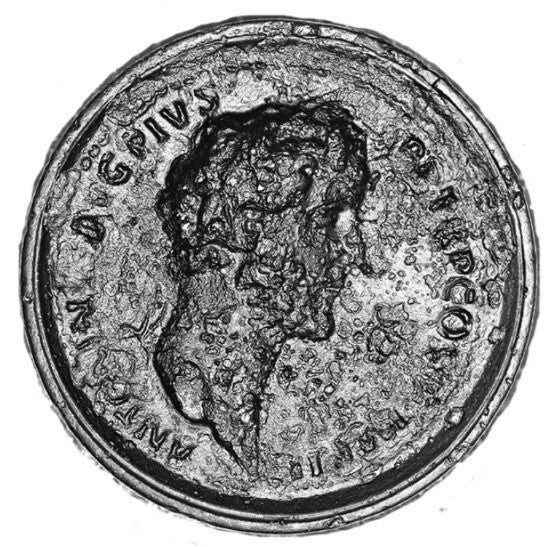
Top of lid (KHM-Museumsverband, Vienna, Austria).
Find 2
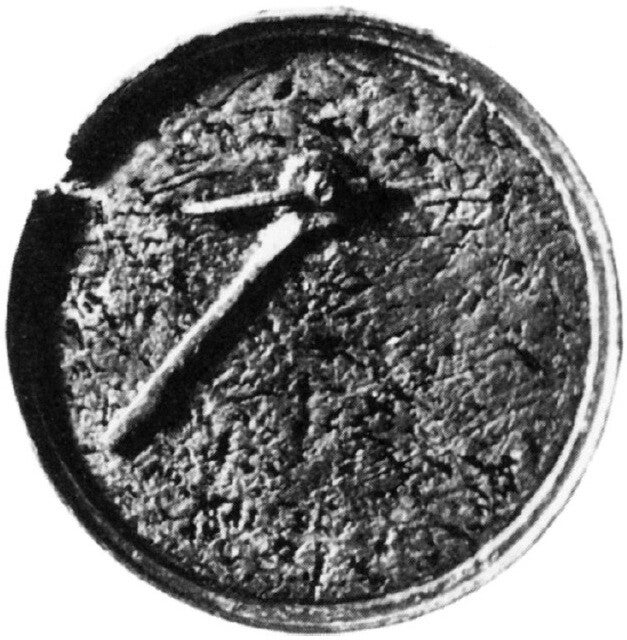
Inside of the box with ruler and grid for the hours and months (KHM-Museumsverband, Vienna, Austria).
Find 3
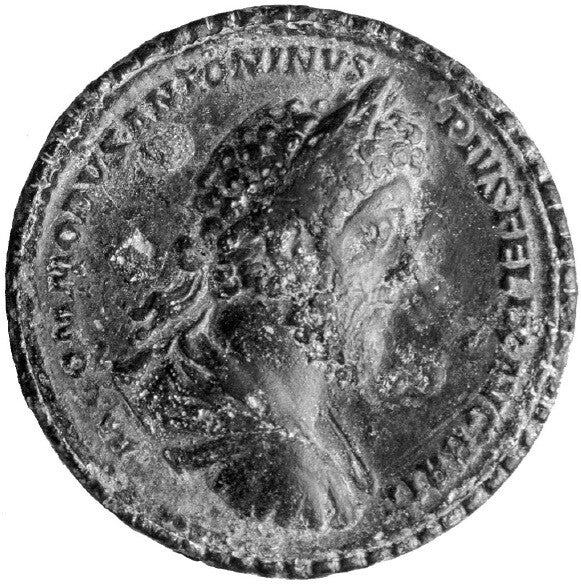
Top of lid (il Museo Nazionale Romano e l’Area archeologica di Roma).
Find 3
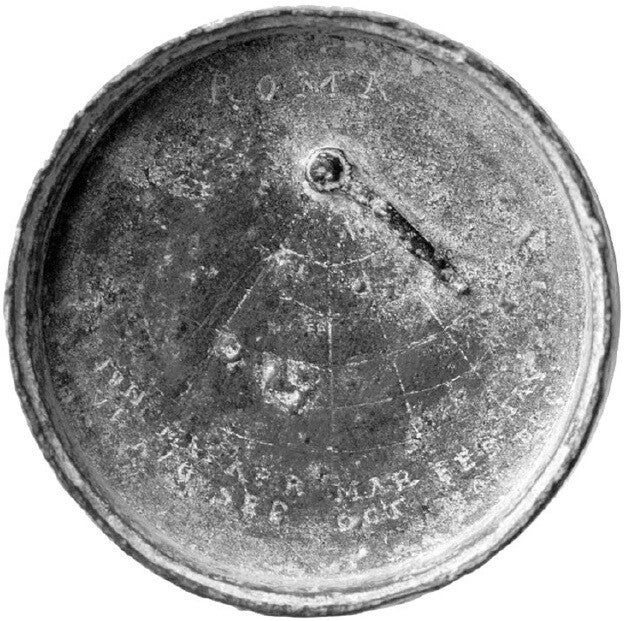
Inside of the box with ruler and hour & month grid (il Museo Nazionale Romano e l’Area archeologica di Roma).
Find 4
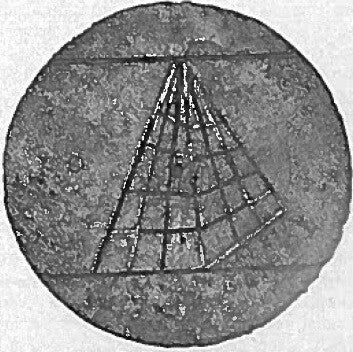
Disc with grid for the hours and months (Civici Musei di Trieste, Italië).
Components
Components of the medallion sundial
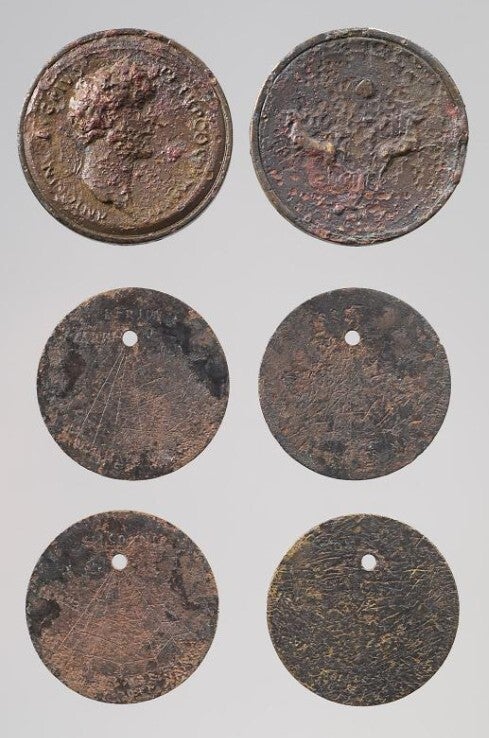
The original (KHM-Museumsverband).
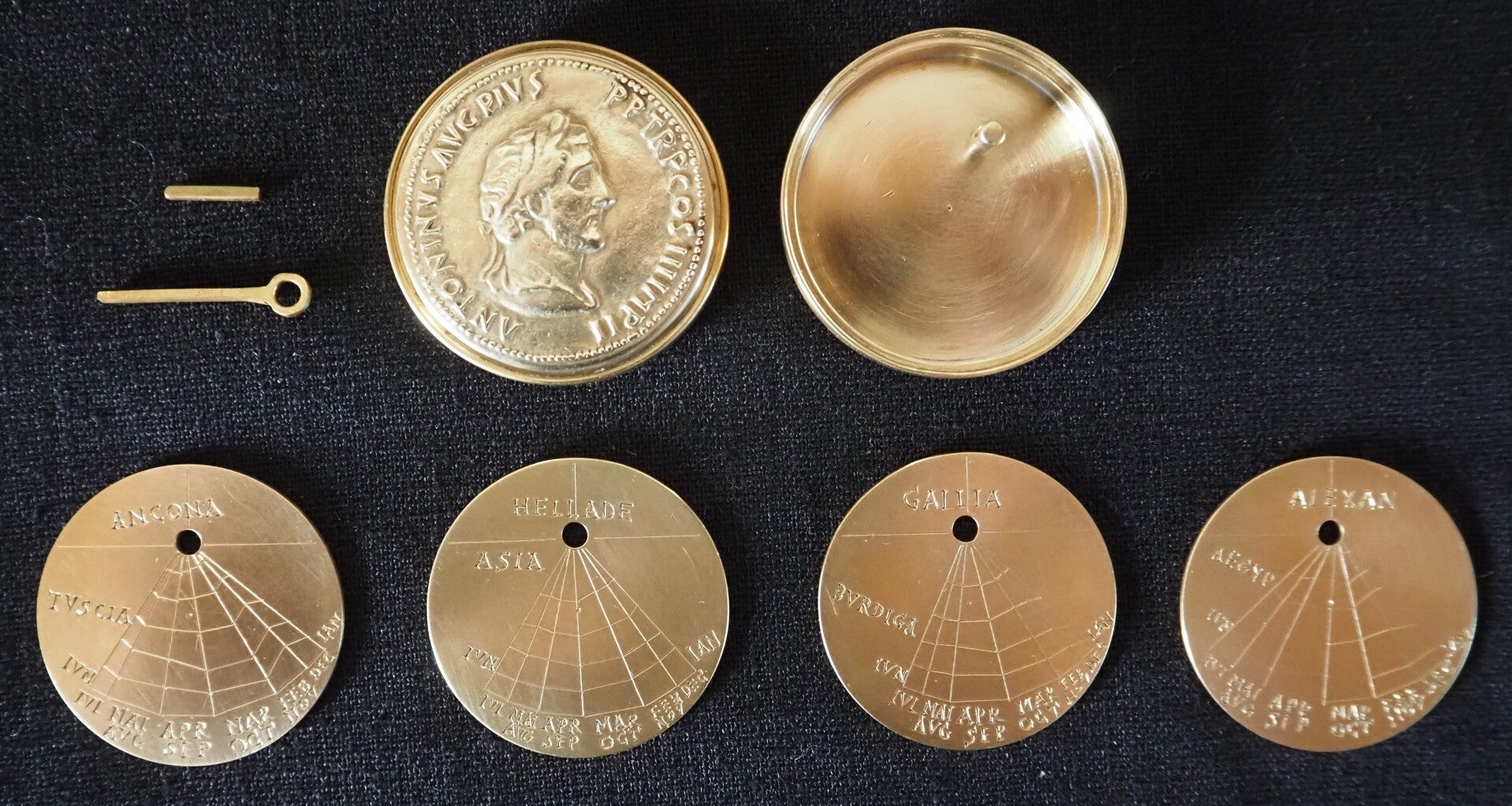
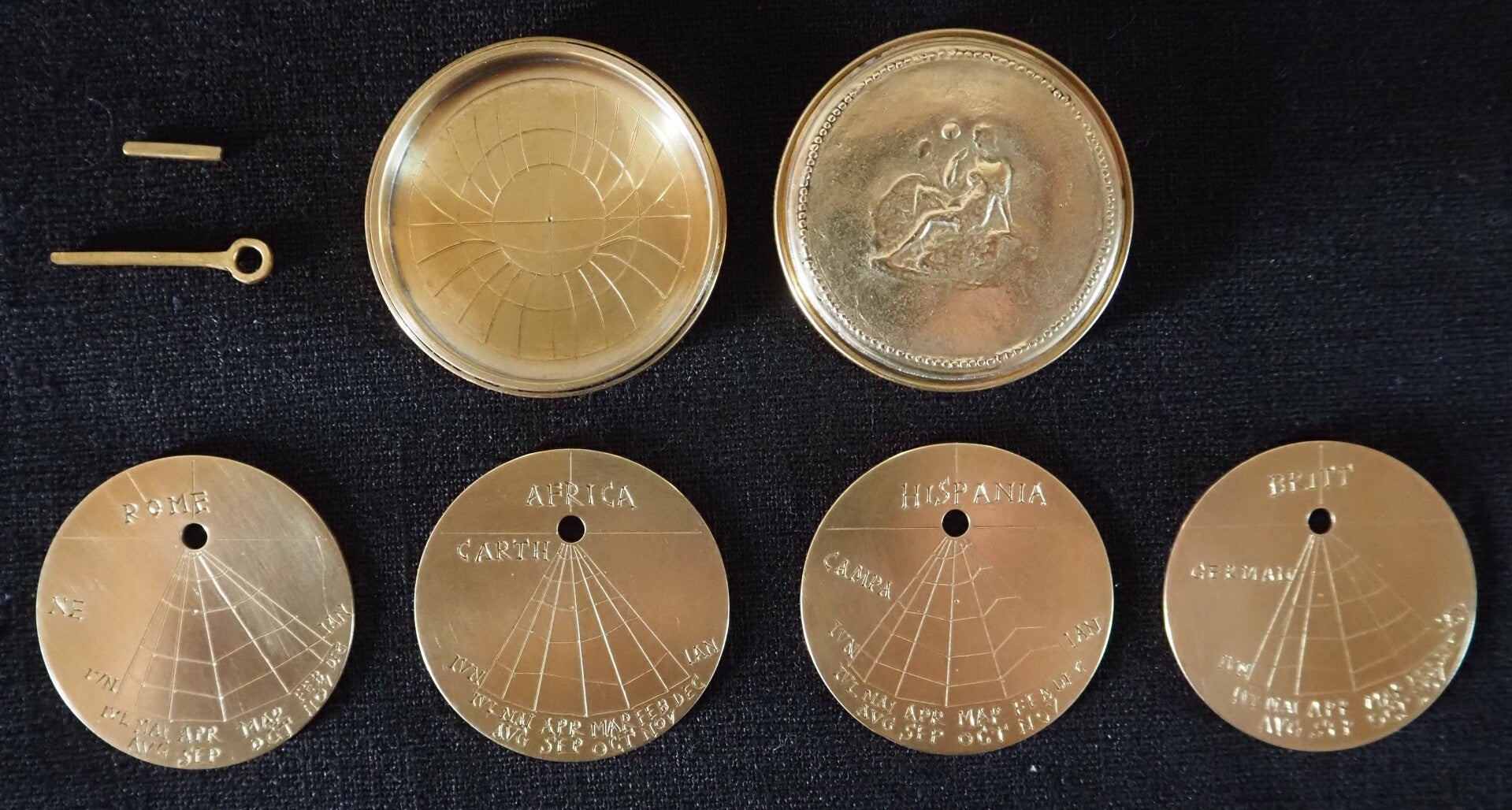
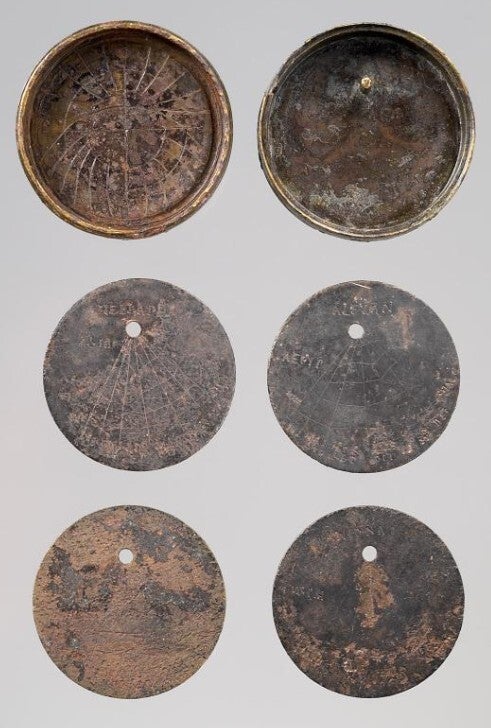
The reproduction.
The medallion sundial consists of several components.
Lid
- The image of Emperor Antoninus Pius is on the top of the lid. On the circumference the emperor's honorary titles are listed.
- A stereographic projection of latitudes and seasonal hours is engraved on the inside.
Box
- The original features a mythological scene on the bottom of the box, whilst the reproduction features the goddess Britannia.
- There is no engraving on the inside of the box. However, the inside contains a pin with a small hole.
Four discs
- This sundial comes with a total of four discs. On both sides of each of these discs, the hour grid for the latitude of a specific location is engraved.
- Each disc has a hole that fits neatly into the pin located on the inside of the box.
Ruler with ring
- The ring of this ruler also fits neatly into the pin located on the inside of the box. This ruler is used to set the date (season) and will also display the time.
Wedge
- All parts are secured with this small wedge.
Top of lid
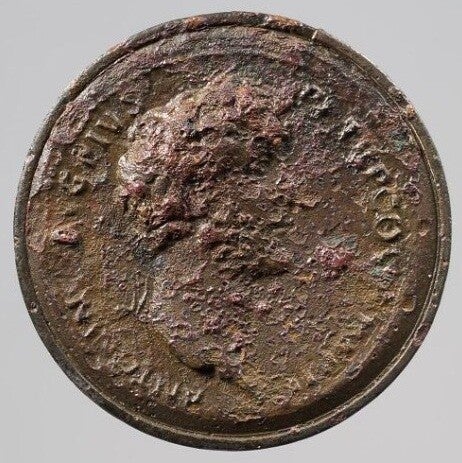
The original (KHM-Museumsverband).
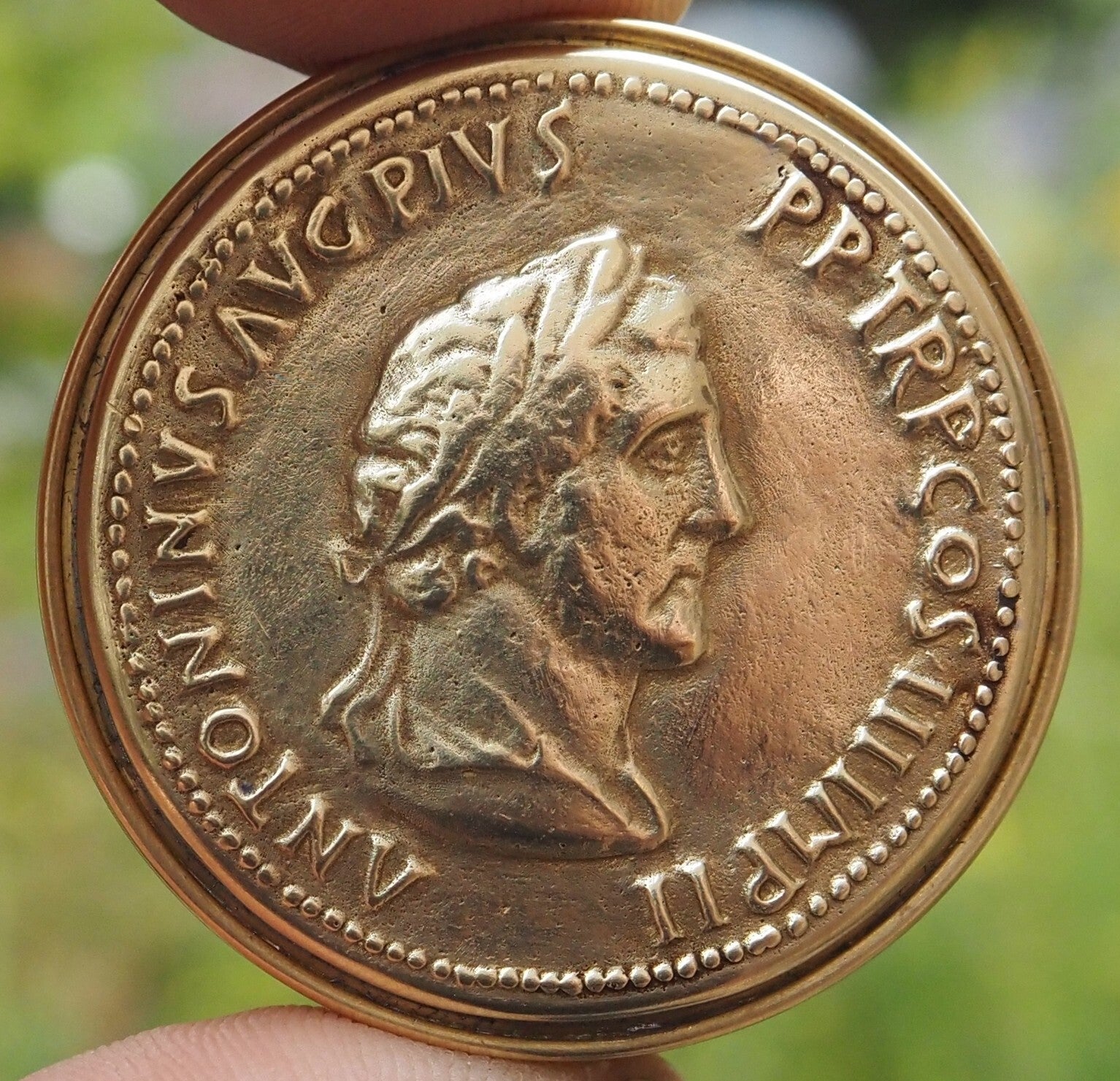
The reproduction.
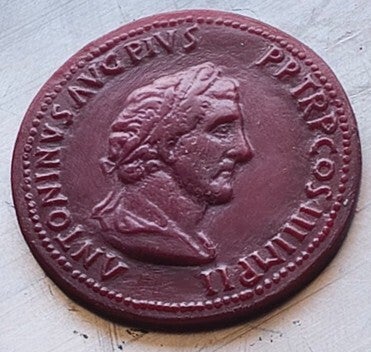
The wax model.
The lid displays the following text:
ANTONINVS AVG PIVS P P TR P COS III IMP II
Meaning:
- ANTONINVS = Antoninus (the emperor's name)
- AVG = Augustus ('the revered one'), the imperial title
- PIVS = Pius ('dutiful' or 'pious'), his honorific surname
- P P = Pater Patriae = 'Father of the Fatherland'
- TR P = Tribunicia Potestate = 'holding tribunician power,' an important constitutional authority that was renewed periodically
- COS III = Consul tertium = 'Consul for the third time'
- IMP II = Imperator secundum (Imperator for the second time)
Which reads as:
'Emperor Antoninus Pius Augustus, Father of the Fatherland, invested with tribunician power, consul for the third time, Imperator for the second time.'
For this reproduction, both the lost-wax and lost-mold methods were used. Consequently, both the wax model and the mold were lost during the creation of the casting form.
The image of the emperor was taken from a copy of a coin based on an archaeological find. The text is identical to one on the original sundial.
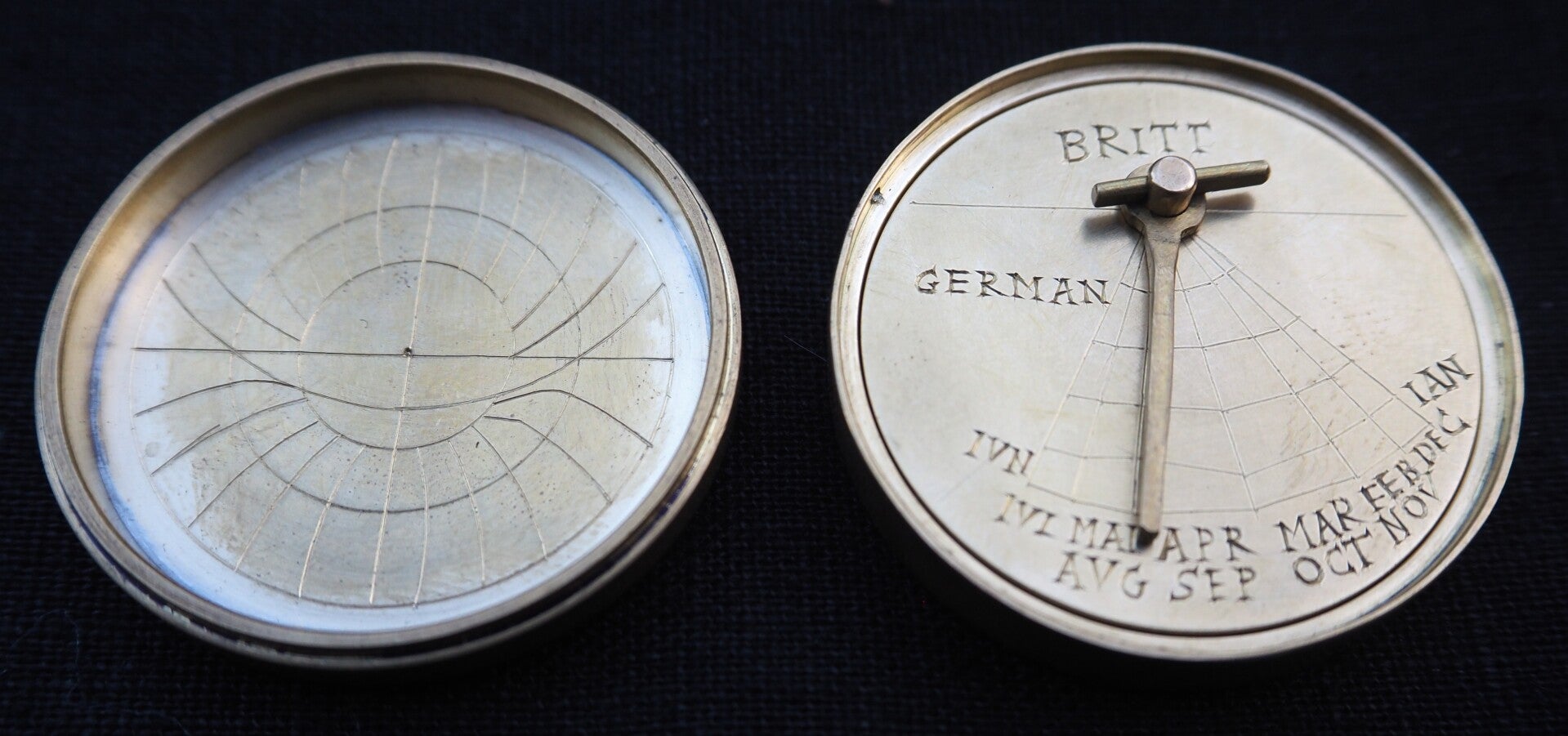
Inside of lid
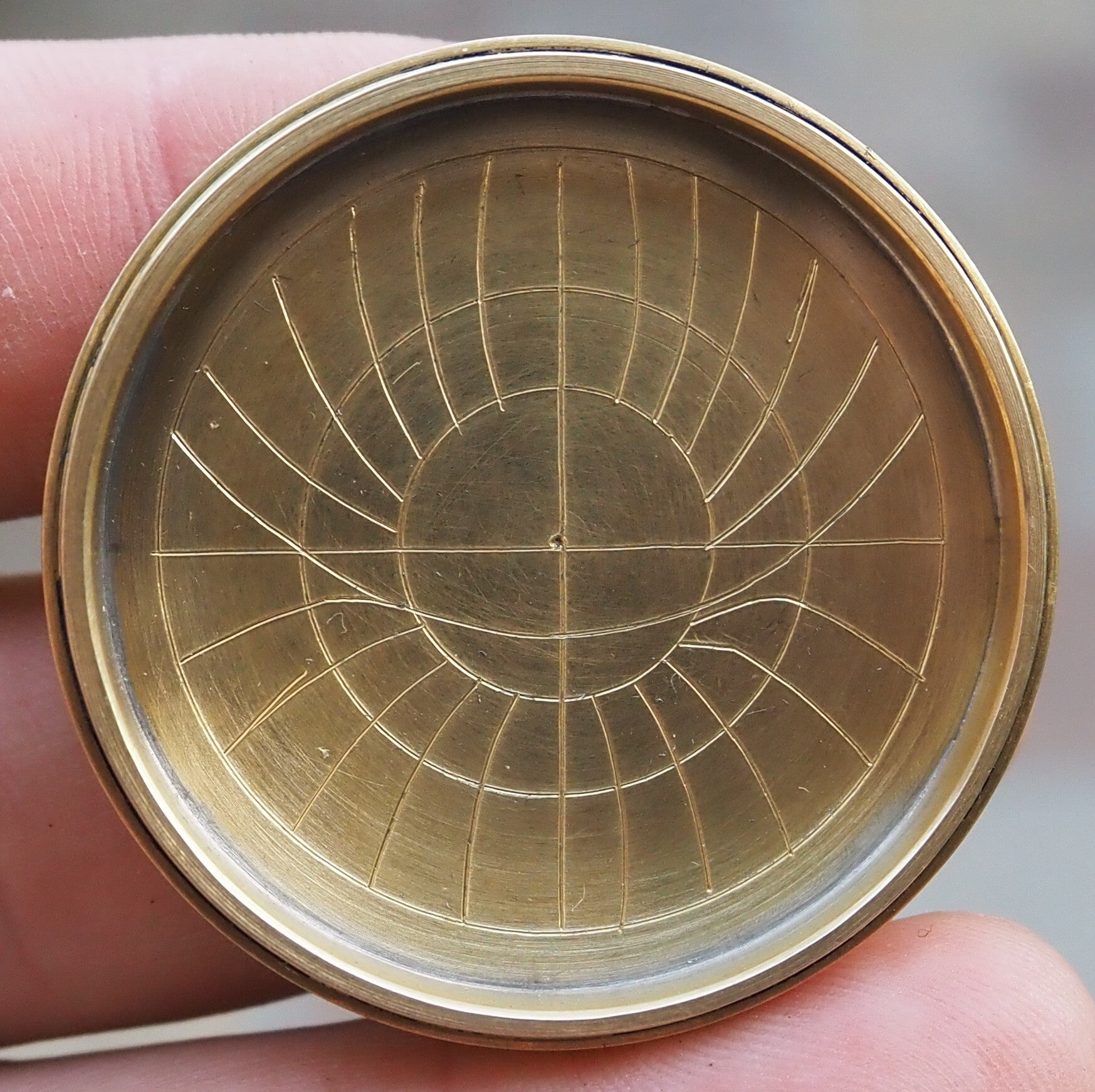
Stereographic projection.
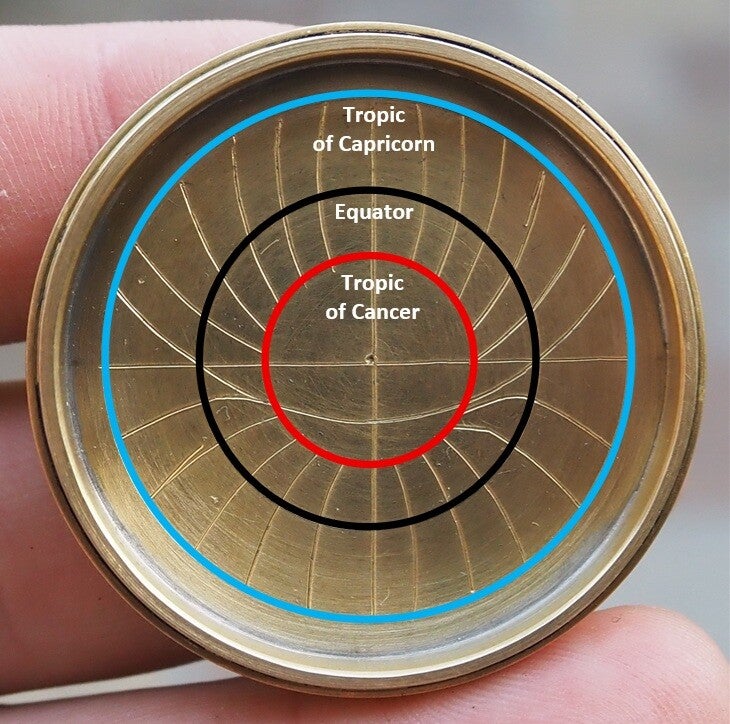
Stereographic projection of the equator and the tropics.
The Greeks knew the Earth is a sphere and they divided this sphere into degrees of latitude. The equator divides the globe into two equal parts. The Tropic of Cancer and the Tropic of Capricorn demarcate the extreme positions of the sun.
The Greeks invented the stereographic projection, which is a mathematical technique to transition from a three-dimensional to a two-dimensional representation.
Using the stereographic projection, the equator and the two tropics of the 3D representation on the globe were projected onto the 2D disc of the sundial. The result (see photo) is the black circle for the equator, and the red and blue circles for the tropics.
The curved lines represent the seasonal hours. However, at the bottom, these are not engraved correctly, which suggests this engraving merely served a decorative function.
Onderzijde doosje
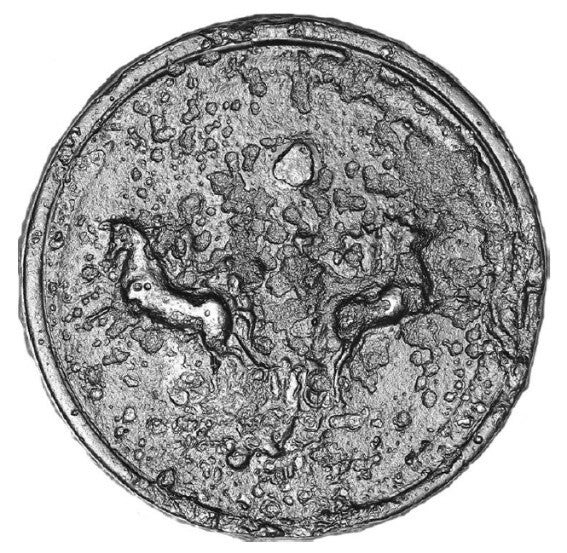
Corroded bottom of the box.
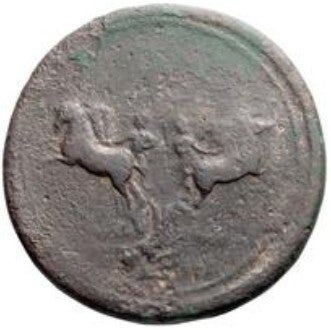
Image of the mythological scene on a medallion from an auction.
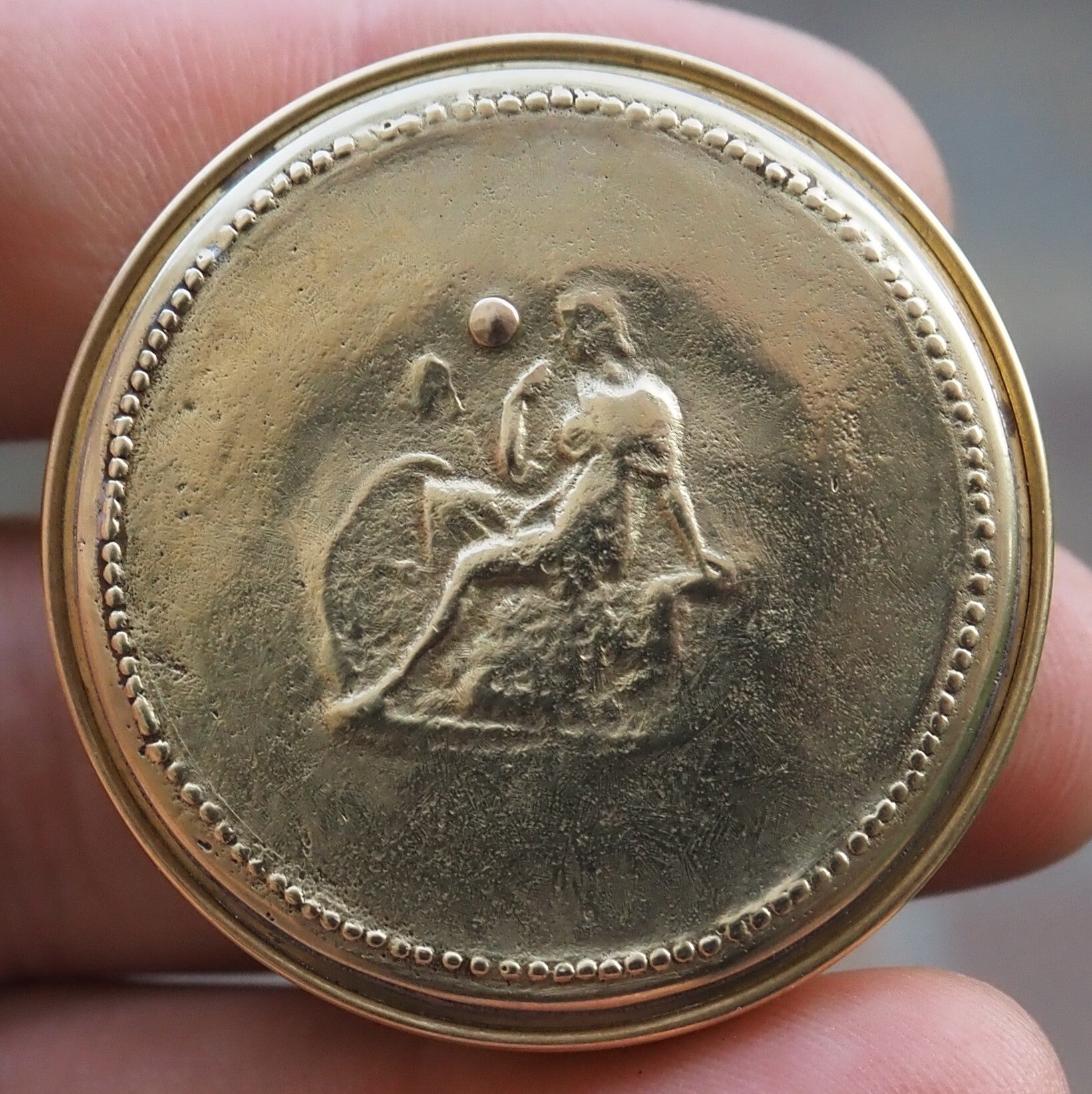
Cast of the goddess Britannia.
The underside of the box is heavily weathered, making the original image barely visible. Fortunately, we found a similar and better-preserved image on an auctioned medallion. A medallion is larger than a coin and can not be used as currency. Medallions were commissioned by emperors and given as exclusive gifts to dignitaries.
The image depicts a scene from Greek mythology. Phaeton, the son of Helios, the god of the sun, falls from Helios's chariot. Above the falling Phaeton, the four horses attempt to escape, two to the left and two to the right. However, they are held back by the two figures between the horses, likely Castor and Pollux (the Dioscuri).
Since we could not find a similar image for the reproduction, we chose to depict the goddess Britannia on the underside. This goddess is derived from the Roman goddess Minerva.
Inside of the box
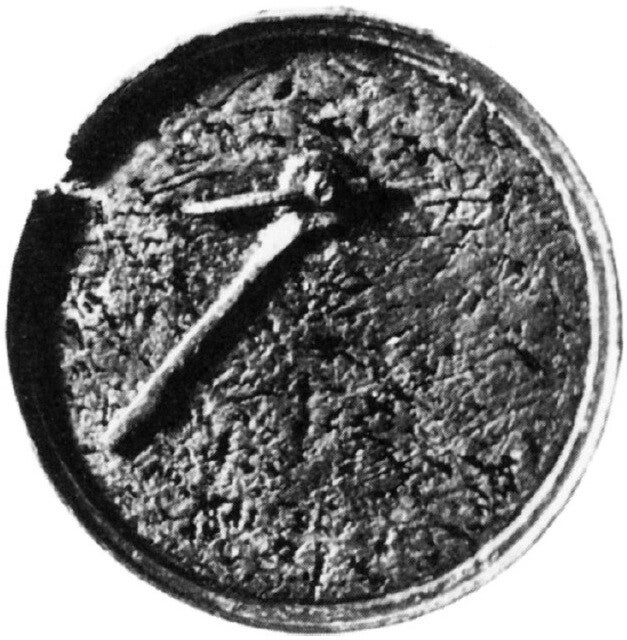
The original (KHM-Museumsverband).
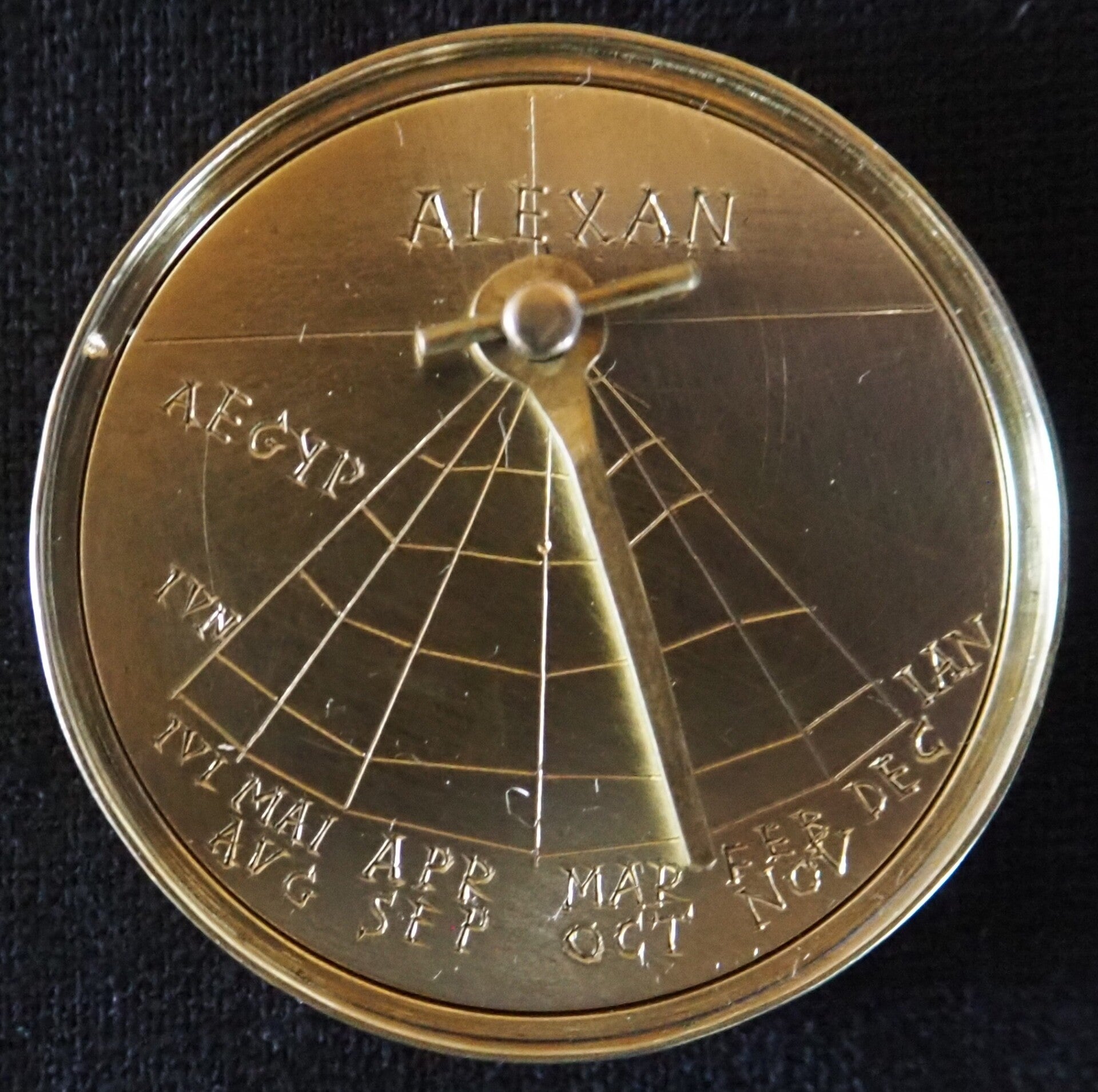
The reproduction.
This is the functional part of this sundial. The ruler and the wedge are clearly visible on the picture of the original. The four plates were corroded and stuck in the box, but were later separated with great care.
To use the sundial, you must follow a four-step process. Each step will be covered in the next section.
Operation
Step 1: Configure the latitude
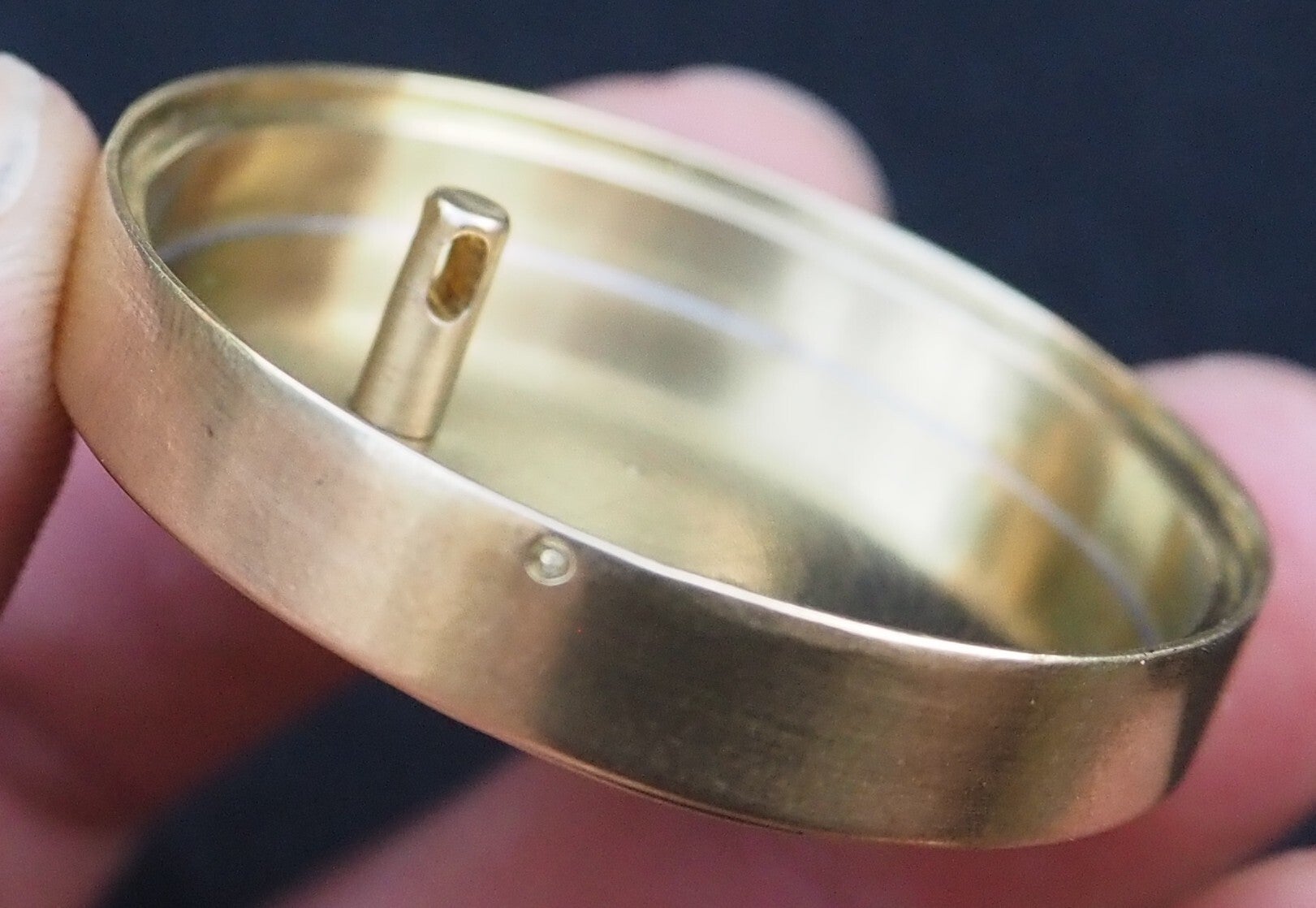
The empty box contains a pin with a hole in it. Also note the hole in the side.
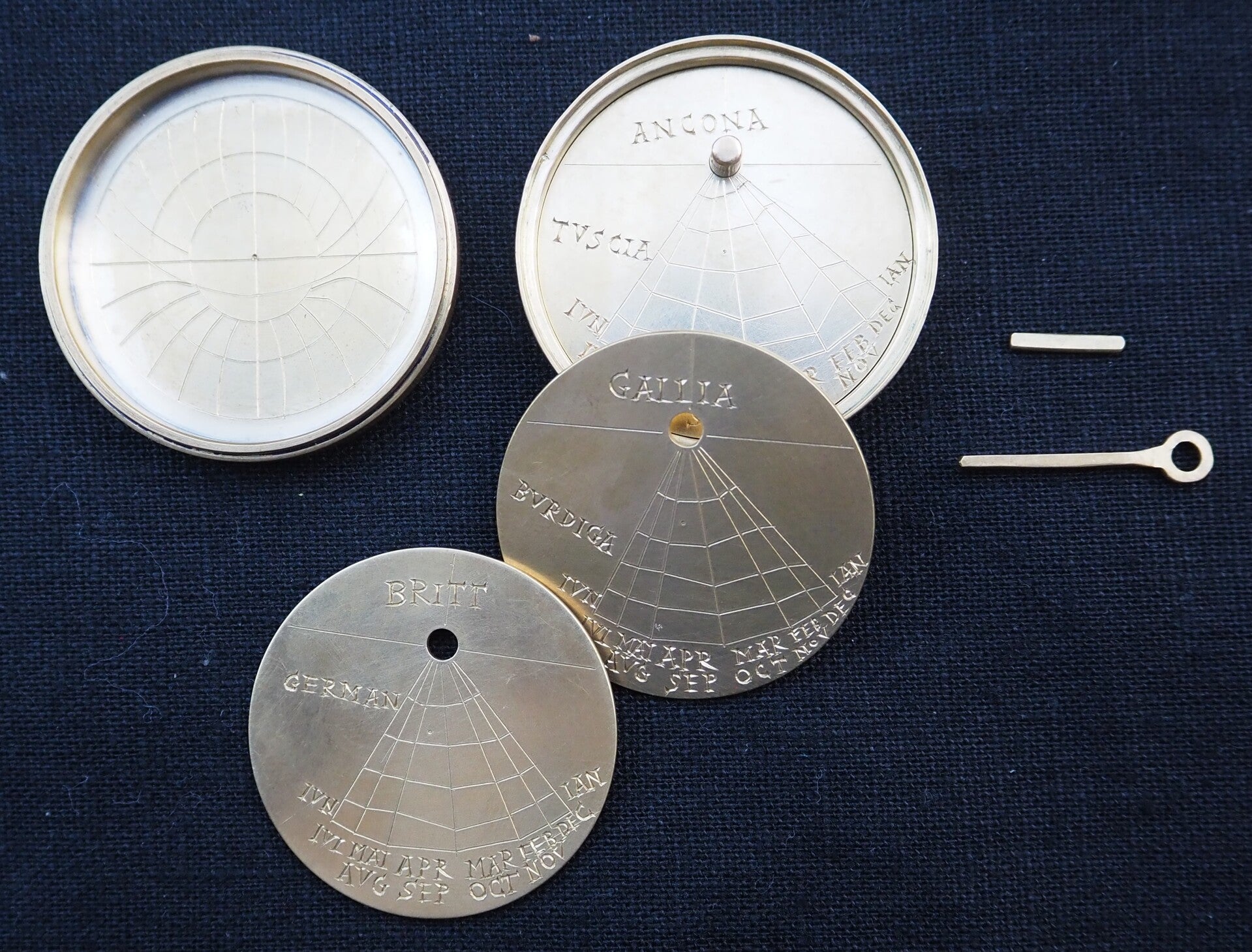
Place the discs in the box.
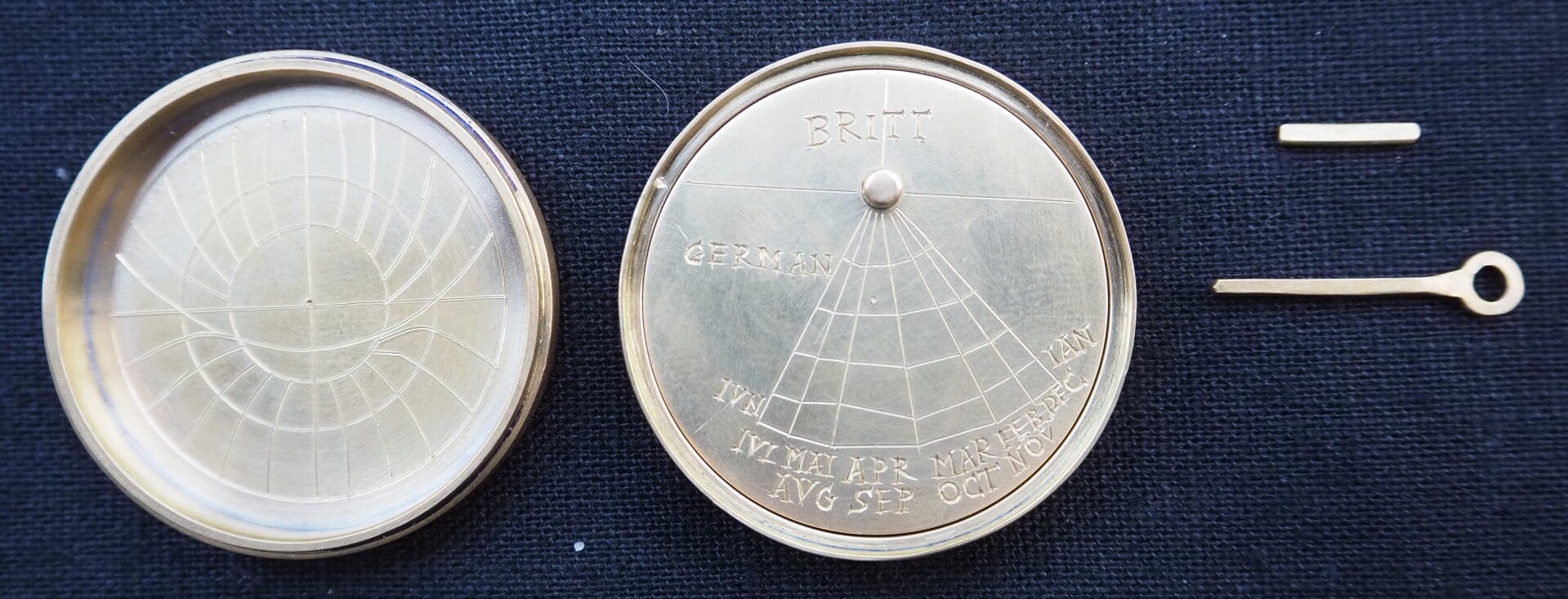
All the discs are in the box.
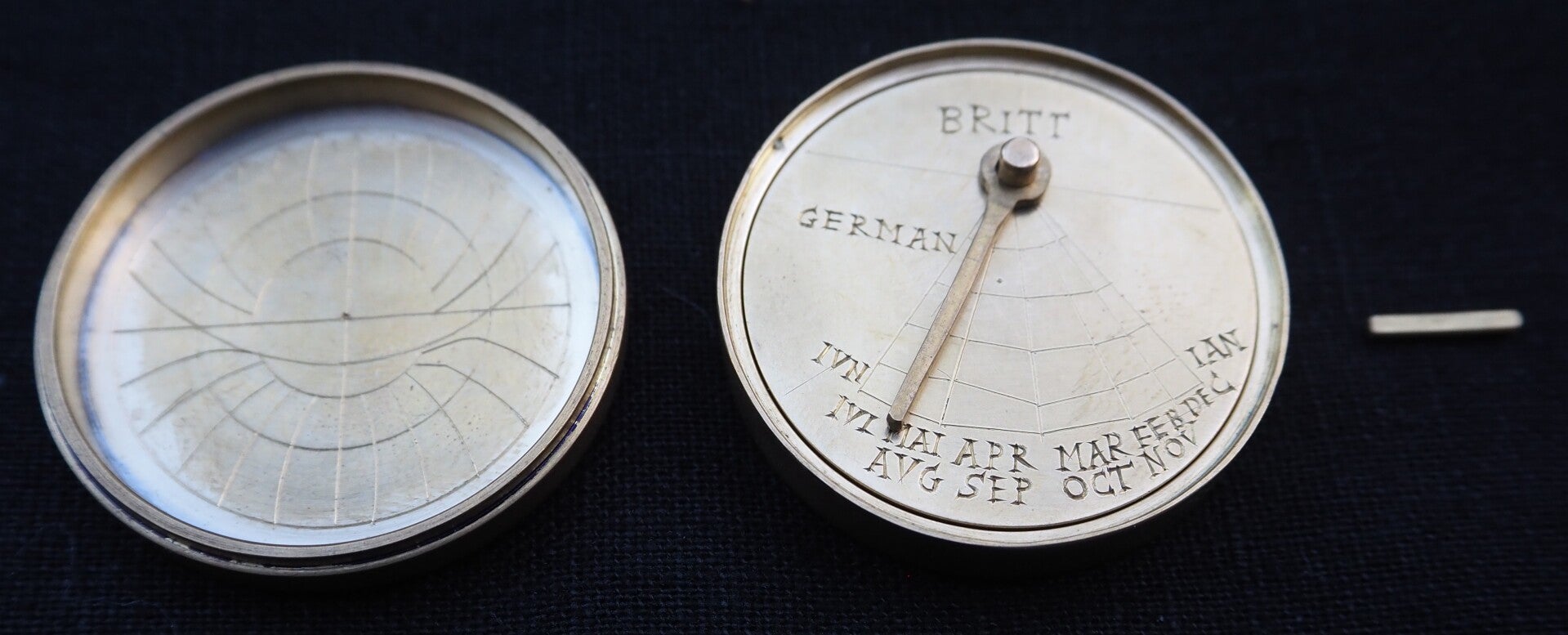
Put the ruler in the pin.
Put the wedge through the hole in the pin.
In order to configure your latitude:
- Put all the discs in the box. The position of the pin in the box, and the hole in each disc will ensure that the discs are properly aligned.
- Make sure the disc with your latitude is on top.
- Put the ring of the ruler into the pin of the box.
- Insert the wedge through the hole in the pin. This will anchor all parts.
Stap 2: Stel je datum in
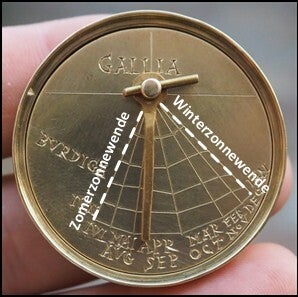
The radial lines represent the months.
The solstices.
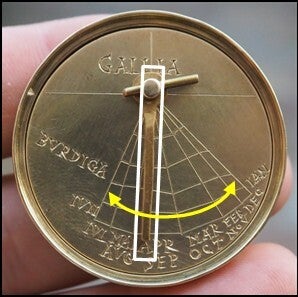
Rotate the ruler until it aligns with the desired date.
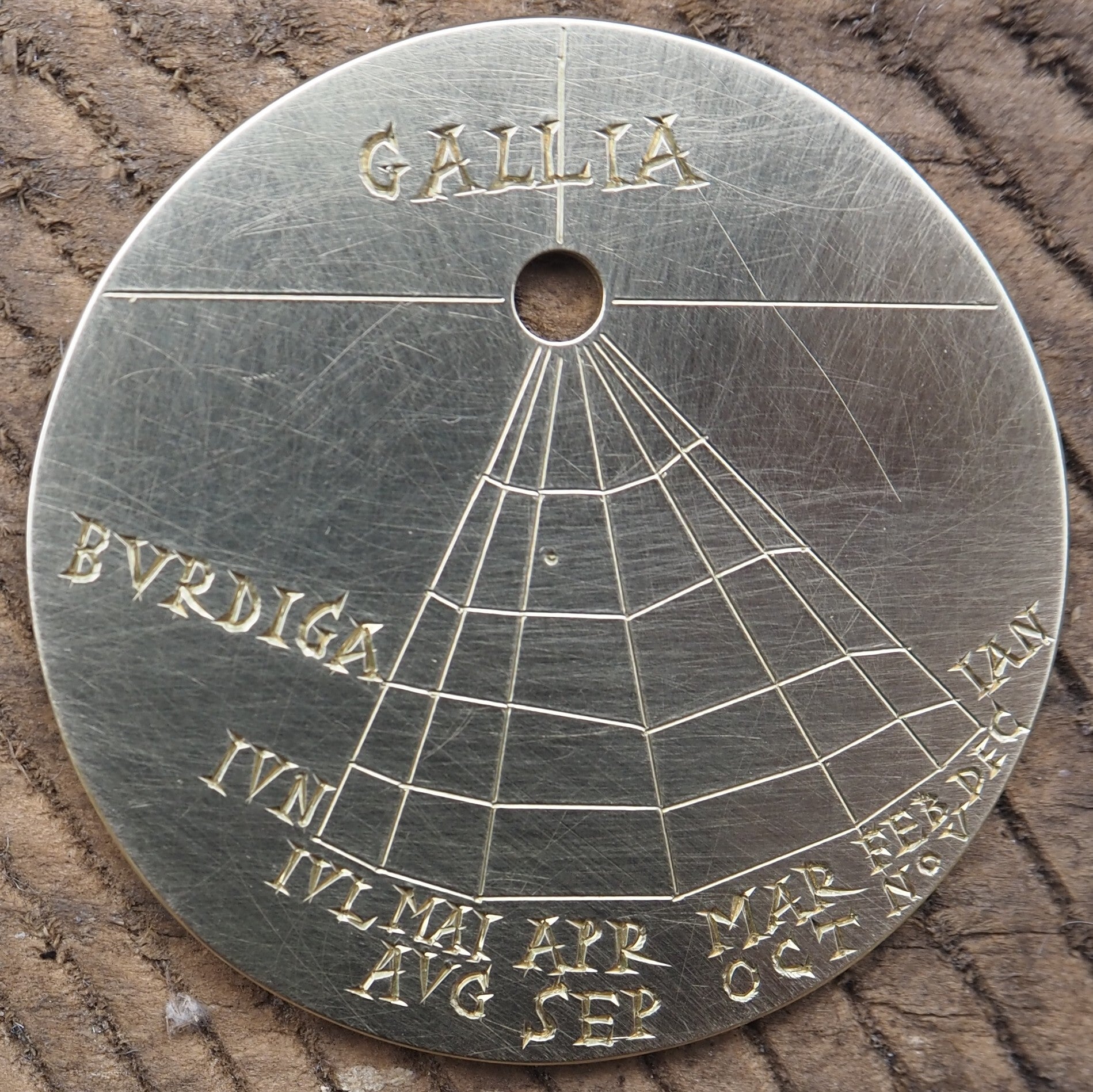
The months are displayed at the bottom of each disc. IAN to IVN (from right to left) and IVL to DEC (from left to right). IAN is the Latin notation for January, IVN for June, and so on.
The outermost line for the month of December (DEC) corresponds to the day with the shortest amount of sunlight: the winter solstice. On the other side of the grid, at June (IVN), stands the day with the longest amount of daylight: the summer solstice.
Every month in the solar year corresponds to a specific season. Depending on the current season, the sun travels another path across the sky. We must take this into account when making the sundial.
We do this by rotating the ruler until it aligns with the desired date.
Step 3: Position the sundial
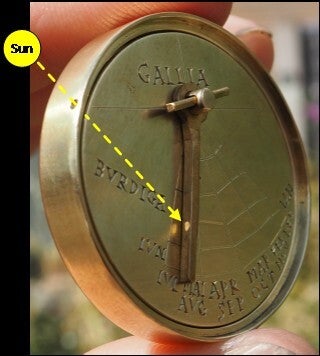
The sunbeam shines through the hole and creates a spot of light on the ruler.
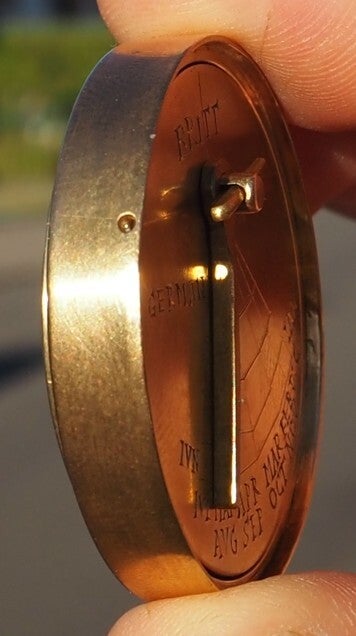
The streak of light does not run parallel to the small bar.
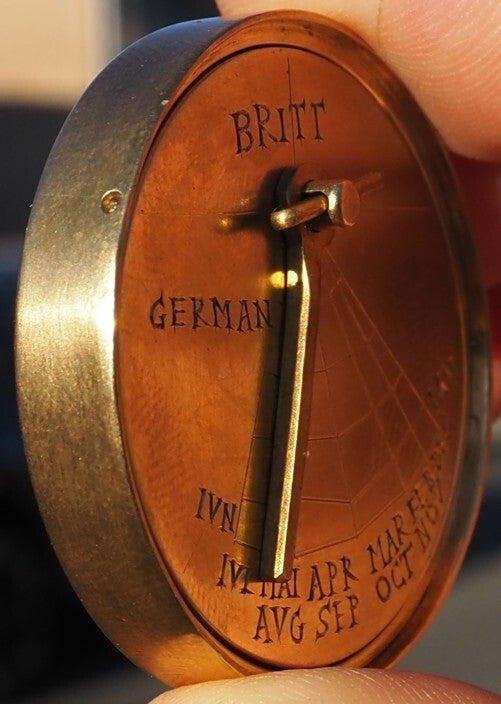
The streak of light runs parallel to the small bar.
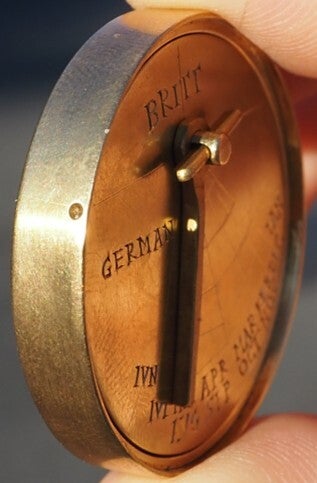
The spot of light must fall in the middle of the ruler.
In the previous steps, we configured the latitude and the date. We can now start using the sundial.
There is a small hole in the rim of the box. We are now going to position the sundial so that a sunbeam shines through that hole. That sunbeam will then create a small light spot on the ruler. This light spot will be our time indication.
1. Light streak runs parallel
- The light streak must run parallel to the ruler. Once the light streak is perfectly parallel, we rotate the sundial until the light streak on the ruler disappears.
2. Light spot in the middle of the ruler
- Next, we must rotate the sundial until the light spot falls nicely in the middle of the ruler.
3. Sundial perpendicular to the Earth's surface
- This last step is the most difficult: ensure that the sundial is positioned perpendicular to the Earth's surface.
- This sundial does not offer good tools for this; only a rough estimate is possible. It is suspected that this sundial was placed in some kind of holder. However, no such holder has been preserved for any medallion sundial.
Step 4: Read the time
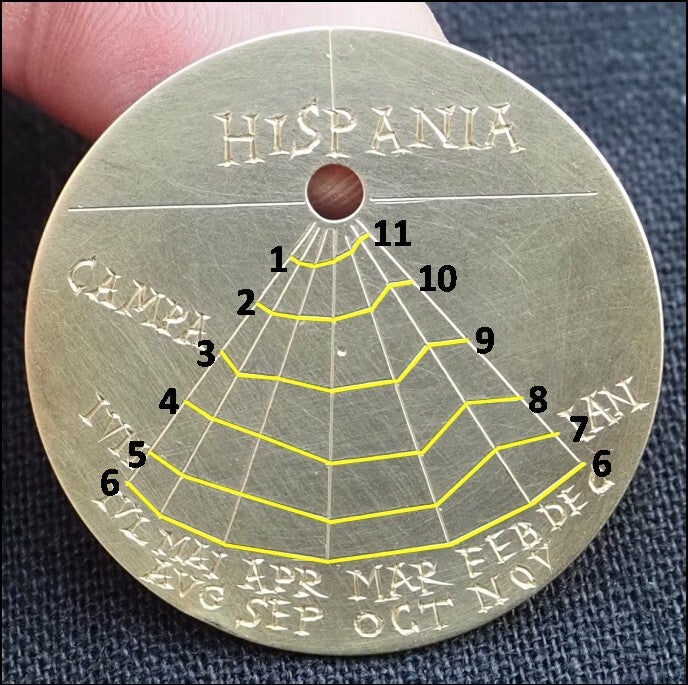
The hour lines on the grid.
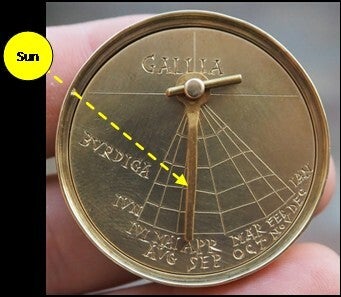
The light point aligns with the hour line on the grid.
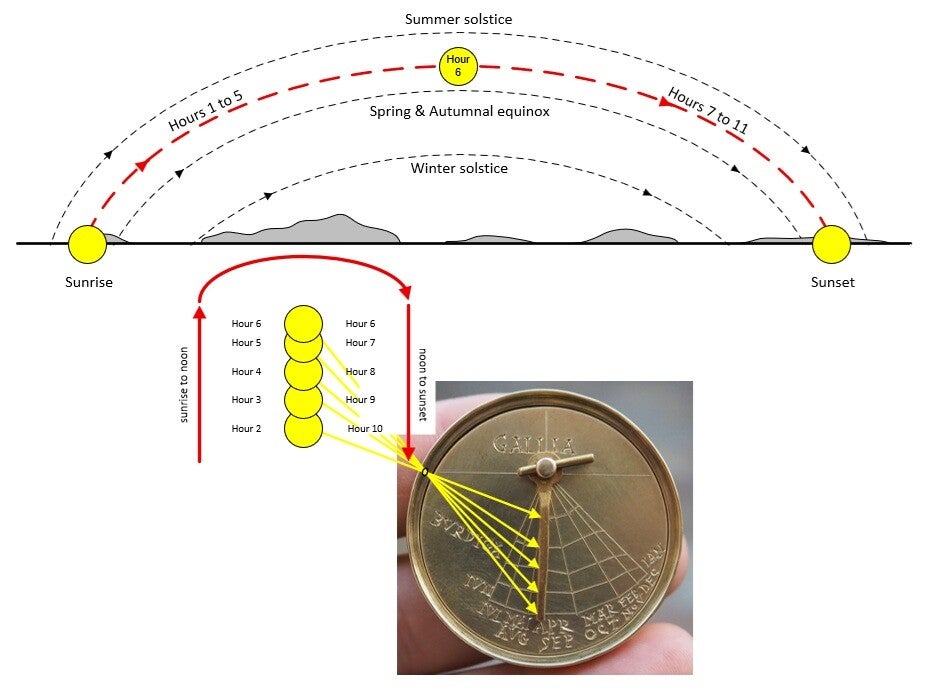
Relationship between the changing position of the sun and the time indication.
The transverse lines on the spiderweb represent the hour lines. Timekeeping starts at sunrise and runs from hour 1 to hour 6. At the 6th hour, the sun has reached its highest point for the day. After that, the sun sets, giving us hours 6 through 11, ending with sunset. Not all discs have hour 1/hour 11 engraved.
In the photo, the sun shines through the hole and creates a point of light on the ruler. The latitude is for the provincia of Gaul, and the 1st hour is not engraved on this disc. The point of light falls just slightly above the transverse line representing the 4th hour. It is therefore just short of 4 o'clock. If midday has already passed, a similar reading on the sundial indicates an hour slightly after the 11th hour.
With thanks to
The book 'Roman Portable Sundials - The Empire in your Hand' by Richard Talbert is an important reference work on portable sundials from classical antiquity. Richard's thorough research ensured that virtually all the information needed for the reproduction was available. Thanks also for the helfull guidelines.
Thanks to Marco Di Francesco, the artist who created the reproduction and made the photos of his artisanal process available.
Thanks also to Nick Vaneerdewegh (Royal Library of Belgium, Coin Cabinet) for the advice regarding the medallion and to Michiel D'huyvetters (KU Leuven Research Group on Ancient History) for establishing the necessary contacts. Furthermore, thanks to Ronny Martens and Jenny Van Rompuy for the advice regarding numastics.
Finally, thanks to Georg Plattner (Kunsthistorisches Museum in Vienna) for the instructions on using the photos from the museum's collection and for bringing this sundial to life in an exhibition at their museum. The black-and-white photos were taken using RTI (reflectance transformation imaging) technology, and my sincere thanks go to the KHM-Museumsverband, Vienna, Austria, for the permission to use these photos.
The document references can be found in Bibliography.